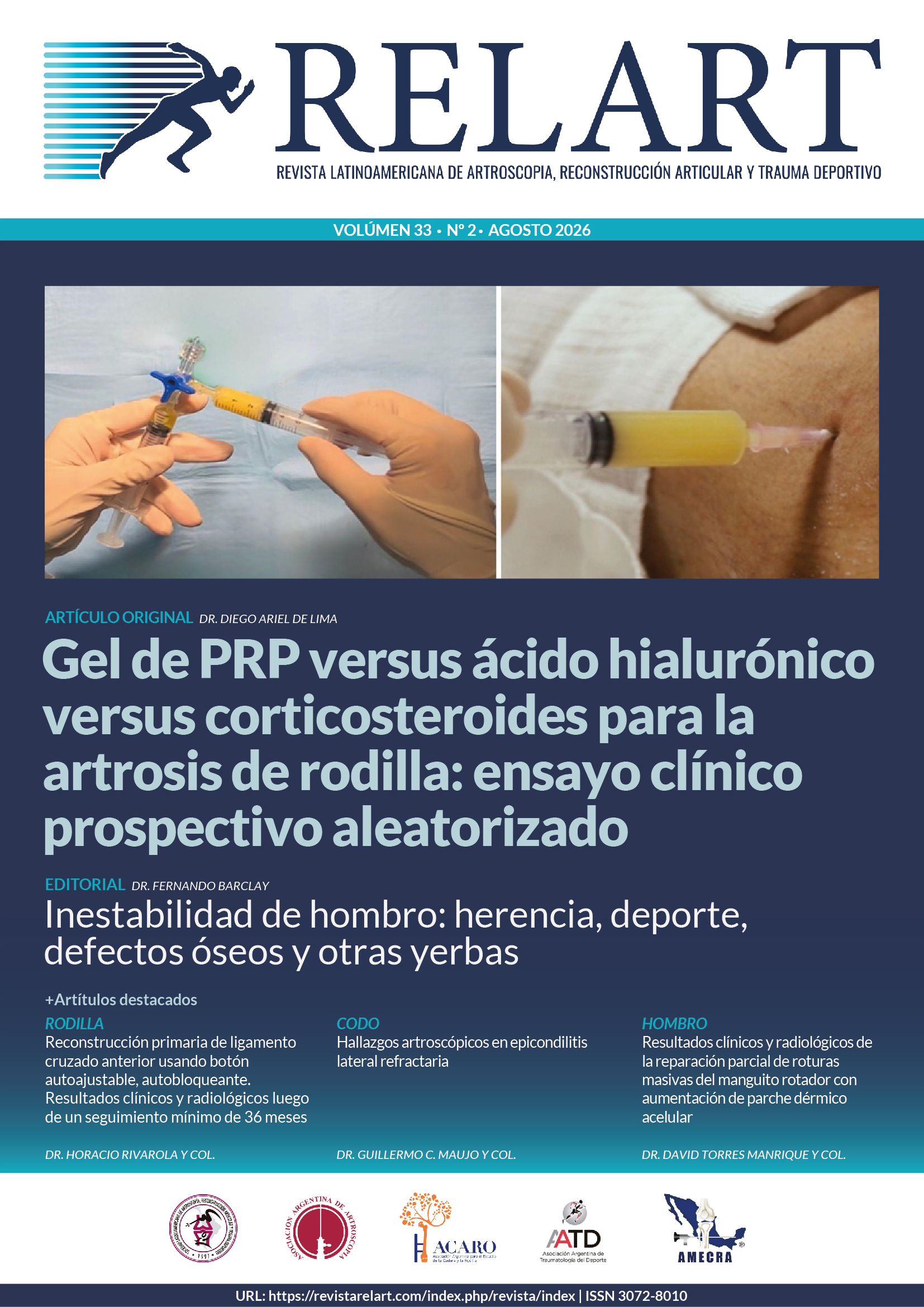
Shoulder Instability: Heredity, Sports, Bone Defects, and More
DOI:
https://doi.org/10.63403/re.v33i2.527Keywords:
Shoulder dislocation, Genetic Predisposition to disease, Joint instability, Sports injuriesAbstract
Drawing on Piaget’s concepts of intellectual autonomy and critical thinking, this editorial reflects on the complexity of managing shoulder instability and challenges oversimplified approaches based on single solutions. Current evidence indicates that hereditary predisposition plays a significant role in the development and recurrence of shoulder instability, although it is not the sole determinant. Genetic, anatomical, and functional factors interact with trauma and sports participation. The future challenge lies in identifying high-risk patients and personalizing treatment decisions beyond the selection of a specific surgical technique.
Downloads
References
Khoschnau S, Melhus H, Jacobson A, Rahme H, Bengtsson H, Ribom E, et al. Type I collagen alpha1 Sp1 polymorphism and the risk of cruciate ligament ruptures or shoulder dislocations. Am J Sports Med. 2008;36(12):2432-6. DOI: https://doi.org/10.1177/0363546508320805
Collins M, Posthumus M, Schwellnus MP. The COL1A1 gene and acute soft tissue ruptures. Br J Sports Med. 2010;44(14):1063-4. DOI: https://doi.org/10.1136/bjsm.2008.056184
Leal MF, Belangero PS, Cohen C, Figueiredo EA, Loyola LC, Pochini AC, et al. Identification of suitable reference genes for gene expression studies of shoulder instability. PLoS One. 2014;9(8):e105002. DOI: https://doi.org/10.1371/journal.pone.0105002
Published
How to Cite
Issue
Section
License
Copyright (c) 2026 Fernando Barclay

This work is licensed under a Creative Commons Attribution-NonCommercial-ShareAlike 4.0 International License.
This work is published under a Creative Commons Attribution–NonCommercial–ShareAlike 4.0 International License (CC BY-NC-SA 4.0). The authors retain the copyright.